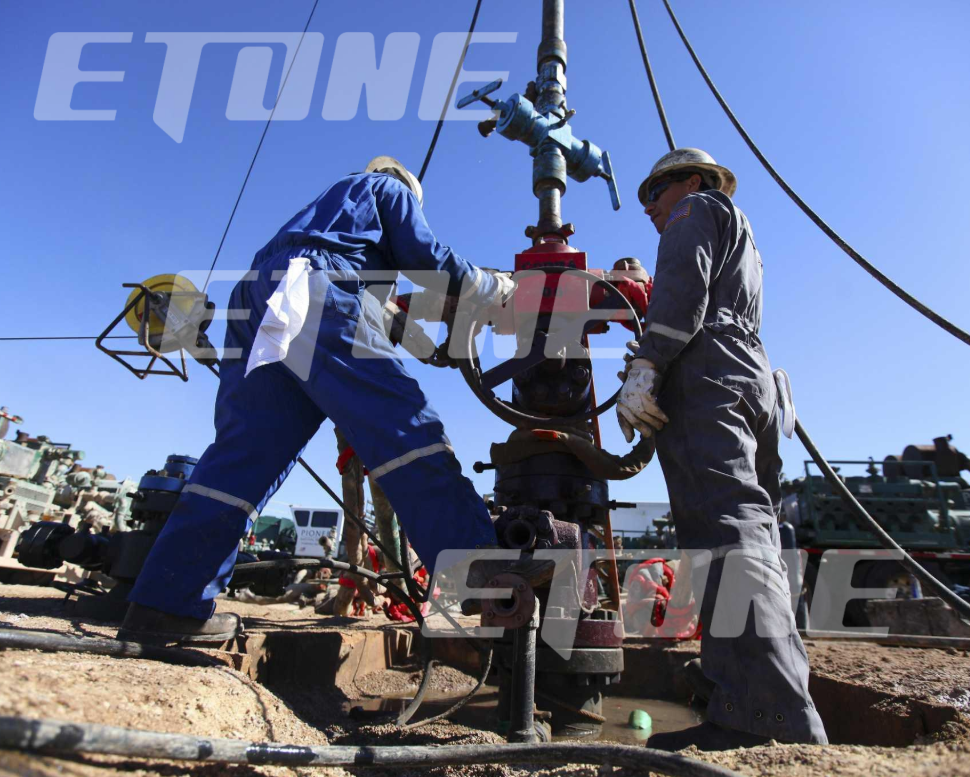
Within high‑pressure oilfield activities such as hydraulic fracturing, well cementing, acidizing, matrix stimulation, and high‑pressure drilling‑mud circulation, triplex and quintuplex plunger pumps with their fluid‑end assemblies function as the core workhorse for surface‑site operations. Built for continuous service under extreme operating pressures ranging from 5,000 PSI to more than 20,000 PSI, these robust positive‑displacement pumps deliver highly abrasive proppant‑laden slurries, corrosive chemical agents, and viscous media down into the wellbore.
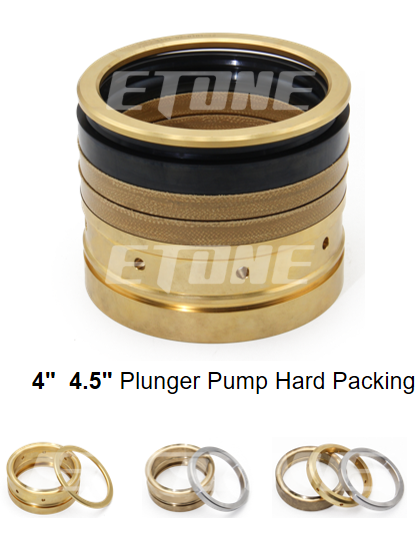
The dynamic sealing system — plunger pump packing, also referred to as pressure packing, fluid‑end packing or V‑packing sets — forms the primary pressure‑containing component inside the fluid end. This vital sealing assembly stops high‑pressure process fluids from escaping along the reciprocating plunger shaft throughout each pumping stroke.
Packing‑component failure triggers instant, costly adverse outcomes: uncontrolled fluid leakage, fluid‑end washout damage, scratched plunger surfaces, site environmental pollution, and unplanned Non‑Productive Time (NPT). For oil‑field operators, such downtime can incur financial losses amounting to tens of thousands of dollars for every operating hour lost.
Field engineers, maintenance supervisors, and procurement specialists must therefore grasp the root causes behind plunger‑pump packing failures and adopt standardized maintenance practices. This full‑scope technical guide outlines the seven most prevalent packing‑related issues occurring during well‑service work, provides step‑by‑step troubleshooting guidance, and illustrates how specifying precision‑manufactured replacement kits from Etone Oil (www.etoneoil.com) helps maximize overall pump uptime.
1. Anatomy of a High‑Pressure Plunger Pump Packing Assembly
Accurate troubleshooting of seal failures requires field‑service personnel to be familiar with every component that makes up a modern oilfield plunger‑pump packing set. Distinct from static gaskets, pressure‑type packing serves as a dynamic sealing system. It is designed to respond to hydraulic‑pressure variation while sustaining consistent surface contact with the moving plunger.
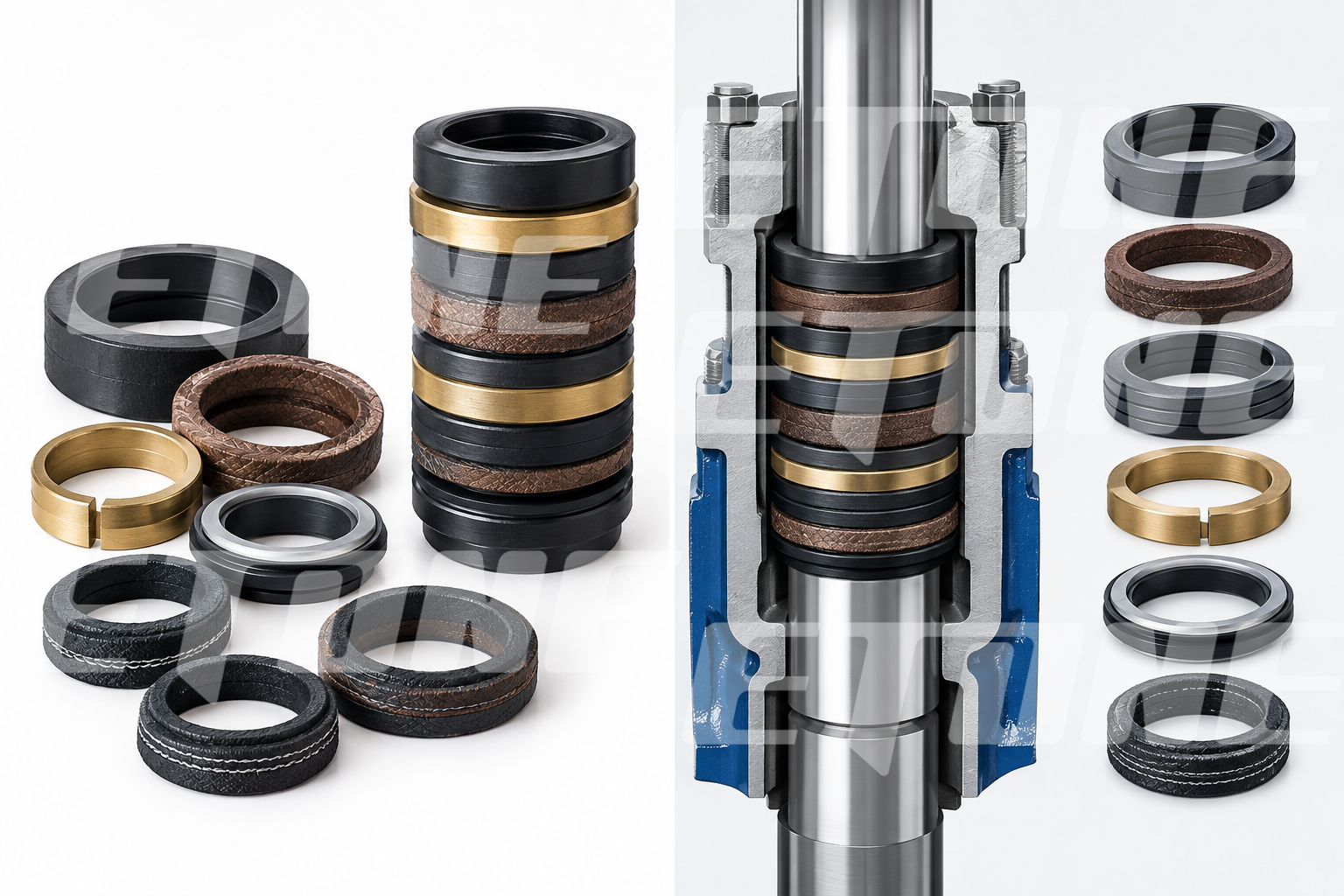
A typical high‑pressure fluid‑end packing assembly is built around four core components:
Top Adapter / Brass Header Ring
Located nearest to the gland nut or spring assembly, this bronze‑brass component evenly spreads mechanical pre‑load across the entire seal stack and blocks seal‑material extrusion into surrounding clearance gaps.
Pressure Rings (V‑Rings / Sealing Rings)
Multi‑lip elastomeric seals constructed from High‑Saturated Nitrile (HNBR), Fluorocarbon (Viton/FKM) or Nitrile (NBR), and reinforced with Kevlar, aramid fiber or cotton‑duck fabric. Driven by system fluid pressure, these rings expand radially against both the stuffing‑box bore and plunger outer surface to establish a leak‑proof fluid seal.
Anti‑Extrusion Rings
Rings made of high‑strength engineered plastics (PEEK, Nylon, filled PTFE) or bronze, installed behind the soft sealing lips. Their function is to withstand deformation induced by extreme operating pressure.
Lantern Ring (Flush Ring)
A perforated metal or composite ring fitted inside the packing stack. It routes flush water or oil‑field lubricant straight onto the plunger surface to dissipate frictional heat and wash away abrasive proppant particles.
2. Problem 1: Premature Abrasive Wear and Sand Scoring
Symptom & Field Observation
During hydraulic fracturing and cementing operations, fine‑particle proppant slurries — including silica sand, resin‑coated sand and ceramic proppant — bypass the wiper seal and invade the packing cavity. This condition leaves deep longitudinal scoring marks on the plunger surface, while the inner sealing lips of the plunger pump packing become rounded, heavily abraded, or worn completely flat far ahead of their projected service lifespan.
Root Cause Analysis
Flush System Failure: Inadequate flush‑water flow rate or insufficient flush pressure fails to clear away abrasive proppant particles. Instead of being flushed out, these hard particles migrate upstream into the packing stack.
Wiper Seal Degradation: Worn or missing plunger wiper seals fail to scrape sand slurry off the plunger during the return suction stroke.
Sub-Standard Packing Material: Using standard unreinforced nitrile (NBR) packing in heavy proppant conditions causes rapid elastomer erosion.
Solution & Preventive Action
Upgrade Seal Metallurgy & Elastomers: Switch from standard NBR to Kevlar-reinforced HNBR Plunger Pump Packing provided by Etone Oil. The aramid fiber matrix acts as an armor shield against abrasive slurry penetration.
Inspect Plunger Coatings: Replace scored plungers with flame-sprayed Colmonoy 56/88 or tungsten carbide-coated plungers to maintain a smooth micro-finish
3. Problem 2: Thermal Degradation and Heat Hardening
Symptom & Field Observation
Packing material becomes hardened, brittle, and glass‑textured, with micro‑cracks forming along its dynamic sealing lips. Under extreme conditions, the elastomer will char or melt, bonding onto the stuffing‑box bore and triggering catastrophic fluid leakage along the plunger shaft.
Root Cause Analysis
Inadequate Lubrication: When the supply flow of rock drill lube or synthetic packing oil falls below specification, friction between the plunger shaft and compressed packing lips creates localized hot‑spots surpassing 300 °F (149 °C).
Excessive Gland Nut Pre‑Load: Over‑torquing the gland nut mechanically compresses the V‑packing stack. Excessive contact pressure against the plunger builds substantial frictional heat.
Incompatible Polymer Choice: Conventional Nitrile (NBR) undergoes rapid material degradation under sustained operating temperatures above 212 °F (100 °C).
Solution & Preventive Action
Optimize Lubrication Delivery: Verify lube‑pump performance, check valve function, and lantern‑ring alignment to ensure rock drill lube or synthetic packing oil is steadily fed into the packing assembly.
Apply Proper Gland Pre‑Load: Adhere strictly to the manufacturer‑provided torque values. Spring‑loaded packing assemblies with internal springs eliminate risks associated with manual over‑torquing by providing constant, self‑compensating tension.
Deploy High‑Temperature Elastomers
For high‑heat fluid‑end operating environments, select plunger pump packing sets constructed from Viton (FKM) or high‑temperature HNBR. These materials are qualified for continuous‑duty performance at temperatures as high as 350 °F (177 °C).
4. Problem 3: Extrusion and Nibbling (Gap Bite)
Symptom & Field Observation
The trailing edges or heels of the V-packing rings appear ragged, torn, or nibbled away. Strips of shredded rubber and fabric matrix accumulate in the lantern ring or gland nut threads.
Root Cause Analysis
Extrusion occurs when fluid end operating pressures force soft elastomer material into micro-clearance gaps between the plunger and the brass header ring or stuffing box bore.
Excessive Clearance Gaps
Worn brass adapter rings or over‑dimensioned stuffing‑box bores widen clearance gaps beyond acceptable limits (greater than 0.010 inch / 0.25 mm).
Pressure Spikes
Operating the fluid end beyond its rated working pressure (for instance at 15,000 PSI), in the absence of high‑modulus backup support components.
Insufficient durometer: Using low-hardness elastomers that lack modulus strength under extreme differential pressure.
Solution & Preventive Action
Incorporate Hardened Anti-Extrusion Rings: Install packing sets featuring PEEK, Bronze, or Kevlar-reinforced anti-extrusion header rings. These rigid components bridge clearance gaps under 15,000+ PSI pressures.
Monitor Stuffing Box Dimensions: Inspect stuffing box internal diameters during overhauls using bore gauges. Re-sleeve or replace fluid end modules if clearance gaps exceed 0.008”.
Use Precision CNC Components: Sourcing Etone Oil Plunger Pump Packing Sets ensures exact dimensional tolerances on all header rings and backup adapters, eliminating gap bite.
5. Problem 4: Rapid Gas Decompression (RGD) & Chemical Attack
Symptom & Field Observation
The packing material swells and softens, accompanied by severe internal blistering and cracking, commonly referred to as the popcorn effect. When deployed for acidizing or sour‑gas service, the elastomer degrades into a viscous, tacky residue and completely loses its sealing pre‑load.
Root Cause Analysis
Explosive Decompression: When operating under high‑pressure gas or hydrocarbon conditions, gas molecules infiltrate the elastomer matrix under working pressure. Rapid pump depressurization causes trapped gas to expand far quicker than it can diffuse outwards, resulting in internal tearing of the rubber seal material.
Chemical Incompatibility: Acidizing fluids containing hydrochloric acid (HCl), hydrofluoric acid (HF), or aromatic‑hydrocarbon‑based carriers will break down standard Nitrile (NBR) and polyurethane seals. These aggressive fluids rupture the material’s polymer molecular chains and trigger seal degradation.
Solution & Preventive Action
Deploy RGD‑Resistant Compounds: Select ED (Explosive Decompression)‑resistant HNBR or Aflas (FEPM) packing sets qualified per NACE TM0192 / ISO 23936‑2 testing standards.
Match Material to Fluid Medium:
6. Problem 5: Improper Pre-Load Tension and Misalignment
Symptom & Field Observation
The packing set leaks immediately upon pump startup after an overhaul, or leaks selectively along one side of the plunger shaft. Inspection reveals uneven ring compression, tilted headers, or cocked V-rings inside the packing cavity.
Root Cause Analysis
Manual Over‑Torquing or Under‑Torquing: In the absence of calibrated torque wrenches or spring‑loaded tensioning hardware, field technicians often improperly adjust gland nuts. Over‑torquing generates excessive frictional heat, while insufficient torque gives rise to immediate low‑pressure blow‑by across the seal.
Cross-Threading & Cocked Installation: Forcing packing rings into the stuffing box using sharp screwdrivers or misaligned drivers damages seal lips and cocks the ring stack.
Plunger Misalignment: Worn pony rod adapters or misaligned power end crossheads cause the plunger to travel at an angle, crushing packing on one side while creating a leakage gap on the other.
Solution & Preventive Action
Use Dedicated Packing Installation Tools: Always utilize smooth, brass, or composite packing insertion tools to seat V-rings squarely without cutting the elastomeric lips.
Adopt Spring-Loaded Packing Systems: Replace manual gland nut adjustment systems with Header Spring Assemblies. Internal stainless‑steel springs sustain consistent, self‑regulating axial pre‑load on the V‑packing stack, even amid pressure swings and thermal expansion effects.
Check Power End Alignment: During major pump overhaul procedures, employ dial indicators to confirm plunger concentricity. This ensures the plunger runs precisely along the central axis of the stuffing box.
7. Complete Oilfield Spare Parts Portfolio from Etone Oil
As a premier manufacturer of high-pressure oilfield replacement parts, Etone Oil (www.etoneoil.com) delivers precision-engineered solutions designed to withstand the harsher working conditions of modern oilfield operations.
In addition to our industry-leading Plunger Pump Packing sets, Etone Oil manufactures a complete suite of flow-line replacement kits:
Plunger Pump Packing Sets: Kevlar-reinforced HNBR, Viton, and Aflas V-packing, header rings, lantern rings, and wiper seals compatible with SPM, Halliburton, Gardner Denver, FMC, and Oilwell pumps.
Plug Valve Repair Kit: Match-ground side segments, heat-treated plugs, inner/outer seal rings, and grease injectors designed for 1502, 1002, and 602 low-torque plug valves.
Flapper Check Valve Repair Kit: Precision CNC-milled flapper plates, hardened hinge pins, high-fatigue torsion springs, and elastomeric body seals for high-pressure check valves.
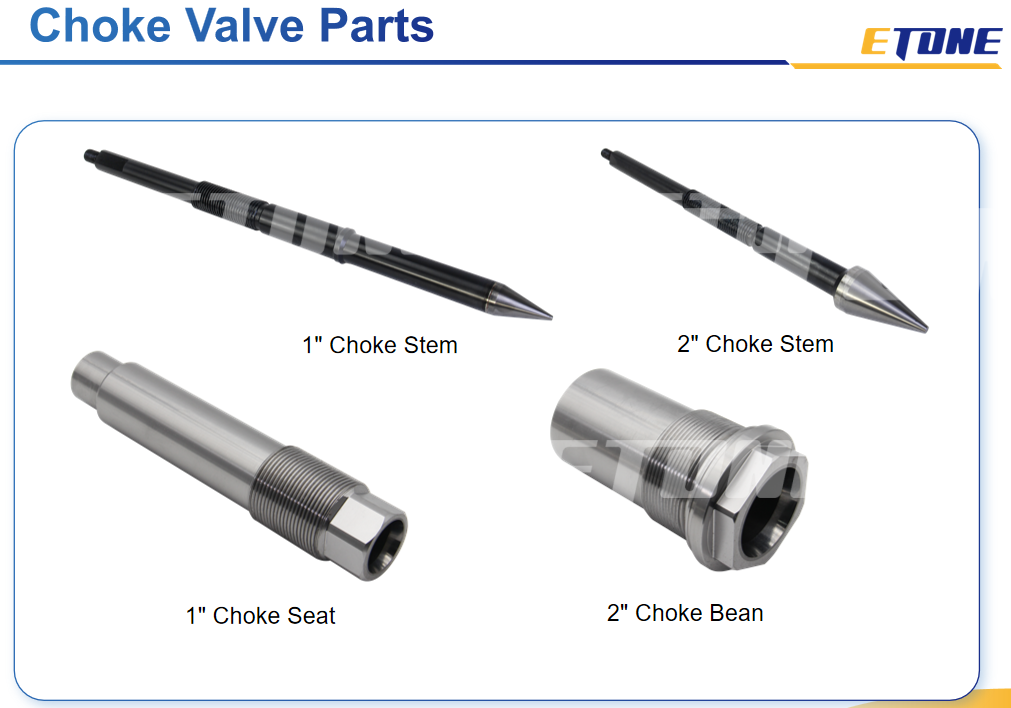
Choke Valve Parts: Premium tungsten carbide stem needles, carbide seat inserts, positive choke beans, stem packing sets, and bonnet seal rings.
Relief Valve Repair Kit: Precision-calibrated stainless steel springs, ground discs, and high-temp seats engineered for mud pump safety valves.
Maximize Pump Uptime with Etone Oil Replacement Solutions
Unscheduled pump downtime caused by packing failure degrades operating margins and delays fracturing schedules. Sourcing precision-engineered Plunger Pump Packing, Plug Valve Repair Kits, and Choke Valve Parts from Etone Oil ensures perfect drop-in fitment, superior wear resistance, and long-term seal integrity under extreme pressure conditions.
Partner with Etone Oil to streamline your supply chain and protect your high-pressure fluid end investments.
Visit www.etoneoil.com today to explore our full online product catalog, download detailed technical spec sheets, or request a fast commercial quote from our engineering sales team at pe@etoneoil.com within 24 hours.