Proper material selection of high‑strength low‑alloy steel for critical oilfield parts plays a pivotal role in determining field operational uptime, regulatory safety adherence, and long‑term drilling economic performance. When exposed to aggressive downhole and surface operating conditions, structural failures within drill collars, mud pump fluid ends, and blowout preventer (BOP) hardware may result in multimillion‑dollar non‑productive time (NPT) losses, alongside potentially severe environmental consequences.
Numerous alloy grades fall within API (American Petroleum Institute) standard specifications, among which AISI 4140 and 4340 oilfield parts serve as the primary mainstream materials widely deployed across the sector. Both belong to the chromium‑molybdenum family of heat‑treatable steels; nevertheless, pronounced discrepancies can be observed in their chemical profiles, mechanical performance limits, through‑hardening capabilities, and overall full‑lifecycle expenditure.
Presenting a direct comparative analysis of AISI 4140 and 4340 oilfield parts, this technical brief supports drilling contractors, procurement managers, and mechanical engineers in making well‑informed material decisions for oilfield equipment assemblies.
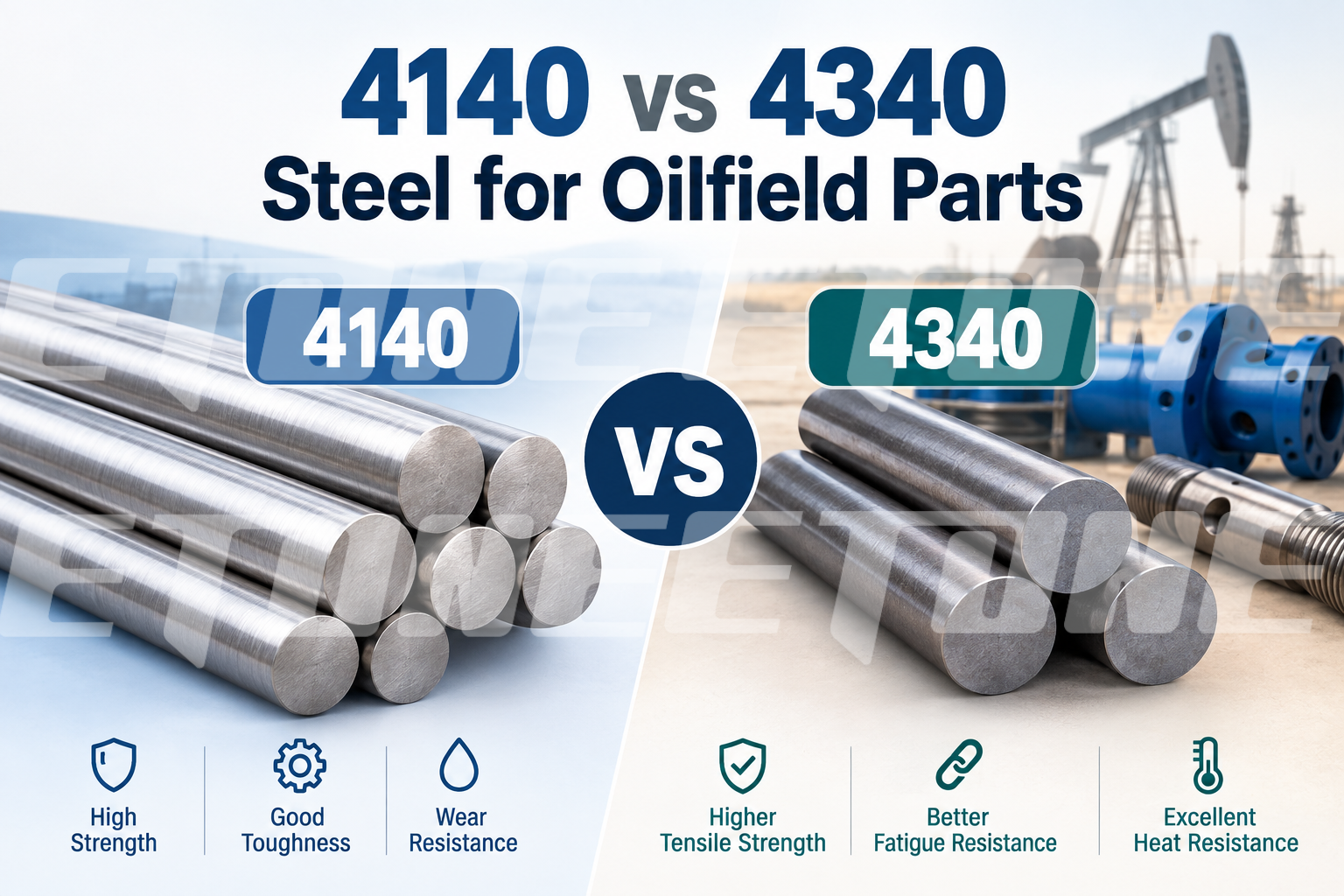
The Difference Between 4140 and 4340
(1) Shared Composition — Identical Specification in Both Grades
| Element | Spec (wt %) | Metallurgical Role |
| Carbon (C) | 0.38-0.43 | Dictates maximum achievable hardness and core strength after quenching |
| Silicon (Si) | 0.15-0.35 | Deoxidizer; strengthens ferrite |
| Phosphorus(P) | ≤ 0.035 | Held to a minimum to avoid intergranular cracking |
| Sulfur (S) | ≤0.040 | Controlled to preserve transverse impact energy |
(2) Differing Elements — The Compositional Gap Between 4140 and 4340
| Element | 4140 (wt %) | 4340 (wt %) | What the Change Delivers |
| Nickel (Ni) | —– | 1.65 -2.00 | The defining upgrade: grain refinement, impact toughness,low-temperatureductile-to-brittleresistance |
| Chromium (Cr) | 0.80-1.10 | 0.70-0.90 | Slightly reduced in 4340; still covers hardenability, wear and scaling resistance |
| Molybdenum (Mo) | 0.15-0.30 | 0.20-0.30 | Raised in 4340 tosuppress temperembrittlement and holdelevated-temperaturestrength |
| Manganese (Mn) | 0.75- 1.00 | 0.60-0.80 | Lowered in 4340; deoxidation and hardenability support shift to Ni |
The Critical Role of Nickel in Oilfield Steel Alloys
What sets AISI 4340 apart at the material level is its roughly 2 % nickel alloying content. Nickel functions as a solid‑solution strengthening agent within the ferrite phase, while maintaining the material’s toughness rather than degrading it. Of greater practical significance, nickel depresses the critical phase‑transition temperature throughout heat‑treatment cycles. This property enables AISI 4340 to develop a complete martensitic microstructure across bulky cross‑sections upon quenching.
For heavy section oilfield parts, including large‑bore drill collars and thick‑walled mud pump fluid ends, AISI 4140 suffers compromised core strength stemming from partial martensite formation during quenching. By contrast, AISI 4340 delivers consistent yield strength, tensile properties and Charpy V‑notch impact toughness uniformly from the outer surface all the way to the component core.
Key Performance Factors for Oilfield Equipment Manufacturing
Four core performance metrics determine the applicability of AISI 4140 and AISI 4340 for critical oilfield parts: through-hardenability, cyclic fatigue resistance, low-temperature toughness, and manufacturability, with 4340’s nickel alloying serving as the key differentiator between the two grades.
Hardenability performance sets clear application boundaries for the two steel grades in oilfield part production. AISI 4140 can only maintain stable, uniform mechanical properties for components with wall thicknesses ranging from 3 to 3.5 inches. For thicker structural sections, slow cooling rates at the core fail to achieve full quenching, forming soft microstructural phases that weaken structural strength and undermine impact resistance. Thanks to its nickel additive, AISI 4340 achieves full martensitic quenching even for cross-sections of 6 inches or thicker. Its uniform mechanical performance throughout the entire component structure makes it the optimal choice for heavy-section forged oilfield equipment.
In terms of dynamic load adaptability, AISI 4140 is qualified for oilfield equipment working under mild and medium cyclic stress conditions, yet it struggles with sustained high-intensity dynamic loads. AISI 4340 delivers far better fatigue life and crack inhibition capability, perfectly matching high-frequency cyclic working scenarios of core equipment such as mud pump crankshafts and top drive shafts. In cold‑climate deep‑sea and arctic oilfield service settings, this nickel‑rich alloy restrains the onset of low‑temperature brittle fracture. Even at ‑40°C, it retains consistent Charpy V‑notch impact performance, guarding against unexpected component failure and mitigating serious safety hazards under frigid operational circumstances.
From a manufacturing and fabrication standpoint, AISI 4140 boasts superior machinability with stable processing performance. In comparison, the nickel composition of AISI 4340 induces work hardening during machining, calling for more precise processing parameters and rigorous heat treatment regulation to guarantee component quality. Both alloys demand standardized welding procedures, with welding discouraged on critical load-bearing oilfield structures.
Application Matrix: 4140 vs 4340 in Oilfield Parts
Matching the correct steel grade to specific downhole and surface components balances operational safety and material procurement budgets.
Downhole Drilling Equipment
Drill Collars and Heavy‑Weight Drill Pipe (HWDP)
AISI 4140 suits standard‑size drill collars (OD below 4.5″) deployed for routine vertical onshore well drilling. For large‑dimension drill collars (max 9.5″ OD), high‑torque directional assemblies and extended‑reach horizontal wells under heavy flexural fatigue, AISI 4340 becomes an indispensable option.
Jar Shafts, Fishing Tools, and Accelerators:
Subject to frequent impact shocks underground, these downhole components leverage 4140 for general‑duty use, while high‑stress jar shafts, fishing tools, and accelerators rely on 4340 for superior toughness and fatigue resistance.
Downhole hydraulic jars deliver high-impact kinetic shock loads to free stuck pipe strings. 4340 steel is chosen for primary inner mandrels and drive sleeves due to its high impact toughness and tensile strength.
MWD / LWD Tool Housings:
Measurement While Drilling (MWD) pressure housings require thin walls, non-magnetic properties (or high strength where magnetic properties permit), and resistance to downhole pressure. 4340 provides high strength-to-weight ratios to prevent wall collapse under severe hydrostatic pressure.
Pressure Control & Wellhead Equipment
Blowout Preventer (BOP) Components
BOP rams, bonnets, and high-pressure valve stems must withstand sharp pressure surges triggered during well‑control incidents. AISI 4140 is commonly selected for conventional wellhead flanges and valve housings. By contrast, heavily loaded internal shafts and impact‑exposed heavy‑duty rams call for AISI 4340 or premium nickel‑base superalloy alternatives.
Mud Pump Components & Fluid Ends
Fluid end assemblies of mud pumps operate under sustained high‑pressure hydraulic cycling exceeding 7,500 PSI, while simultaneously facing erosive wear from abrasive drilling mud mixtures.
4140 is used for standard triplex mud pump fluid ends and fluid-handling valve pots.
4340 is used for heavy-duty quintuplex mud pump crankshafts, eccentric shafts, and high-horsepower fluid ends subject to severe pressure-cycling fatigue.
Quality Assurance & API Standards for Oilfield Parts
When sourcing 4140 and 4340 bar stock, forgings, or completed oilfield parts, buyers should verify that vendors adhere to rigorous oil‑gas industry quality requirements.
API Specification 7‑1 / 6A sets binding standards for mechanical performance, non‑destructive testing (NDT), and dimensional accuracy covering drill stem components and wellhead hardware.
For sour‑gas operating conditions, NACE MR0175 / ISO 15156 governs both steel grades. Precise heat‑treatment practices must be implemented to cap hardness at 22 HRC, mitigating risks of Hydrogen‑Induced Stress Cracking (HISC) and Sulfide Stress Cracking (SSC).
Ultrasonic and magnetic particle inspection (UT/MPI) is also required to screen raw forged billets. This step detects internal flaws such as voids, impurity inclusions, and hydrogen flakes prior to subsequent machining operations.
Partner with Etone Oil for Custom Oilfield Parts
No matter what your drilling project calls for high‑precision AISI 4140 shafts or high‑toughness AISI 4340 forged parts- Etone Oil delivers fully certified, API‑qualified manufacturing solutions built to hold up against harsh field operating environments.
Our Manufacturing Capabilities Include:
Custom CNC machining and deep-hole drilling for long downhole tool bodies.
Advanced heat treatment facilities delivering verified Quenched & Tempered (Q&T) mechanical properties.
Full material traceability with 3.1 Mill Test Certificates (MTC), NDT reports, and strict Quality Assurance.
Global supply chain fulfillment for high-horsepower fluid ends, mud pump parts, and downhole accessories.
Need expert guidance selecting the right steel alloy for your oilfield equipment?
👉 Contact the Etone Oil Engineering Team Today at pe@etoneoil.com or +86 135 3728 5097 to request a technical consultation or obtain a competitive quotation on custom-machined 4140 and 4340 oilfield components!